
Team Benin in Incheon 2026: Eleven Matches, Six Wins and Progress to Build On
98th out of 185 teams, six wins in eleven matches, a highest alliance score of 345 and a climb to Zone 3: our FIRST Global Challenge 2026 recap.
In this article
In Incheon, the competition asked more of us than knowing how to make a robot work. We had to play alongside new partners, make quick decisions, keep going after difficult matches and put months of preparation in Cotonou to the test.
From 7 to 10 October 2026, Team Benin represented the country at the FIRST Global Challenge, under the theme Igniting Innovation. We finished the ranking matches 98th out of 185 teams, with six wins and five losses. That result leaves room to improve, and gives us concrete reasons to be proud of the work we put in.
Our competition in numbers
At FIRST Global, each match result belongs to an alliance of three teams. The scores here belong to the alliances in which Benin played; they are not the points scored by our robot alone. Our position is the ranking-stage result, separate from the ranking of the finalist alliances.
Eleven matches, eleven different situations
Our opening matches brought both wins and difficulties. We won match 17 with Albania and El Salvador, 95–46, then match 88 with Libya and Vietnam, 80–7. Between those wins, and in match 113, our alliances lost. The first day brought us face to face with competition conditions: a robot prepared in the workshop still has to find its rhythm among moving robots and scattered balls.
On 9 October, two losses were followed by two wins: 206–177 with Mauritania and Sri Lanka, then 147–48 with the Republic of Korea and Cuba. Our last match of the day ended in a 109–193 loss. It was a mixed day that asked us to keep playing and adapting, without allowing one result to determine the next.
On 10 October, both of our final alliances won. With Oman and Team Hope, we reached 345–170 in match 281, the highest alliance score of our campaign. With Belize and Lithuania, we then won match 321, 158–134. We finished the ranking stage with two consecutive wins.
| Date / Match | Benin’s alliance | Opposing alliance | Score | Result |
|---|---|---|---|---|
| 08/10 · #17 | Benin · Albania · El Salvador | Barbados · Congo · Estonia | 95–46 | Win |
| 08/10 · #53 | Papua New Guinea · Equatorial Guinea · Benin | Syrian Arab Republic · Maldives · Tanzania | 48–86 | Loss |
| 08/10 · #88 | Libya · Benin · Vietnam | Nigeria · Thailand · Portugal | 80–7 | Win |
| 08/10 · #113 | Serbia · Gambia · Benin | Bhutan · Kosovo · Republic of Moldova | 96–264 | Loss |
| 09/10 · #139 | Zambia · U.S. Virgin Islands · Benin | Mali · Latvia · British Virgin Islands | 71–146 | Loss |
| 09/10 · #156 | Azerbaijan · Benin · Cayman Islands | Lebanon · Liberia · Ireland | 130–299 | Loss |
| 09/10 · #195 | Benin · Mauritania · Sri Lanka | Togo · Hong Kong, China · Sudan | 206–177 | Win |
| 09/10 · #225 | Benin · Republic of Korea · Cuba | Tunisia · Malta · Guyana | 147–48 | Win |
| 09/10 · #254 | Benin · Burkina Faso · São Tomé and Príncipe | Bulgaria · Bosnia and Herzegovina · Saint Kitts and Nevis | 109–193 | Loss |
| 10/10 · #281 | Oman · Benin · Team Hope (Refugees) | Greece · United States of America · Dominica | 345–170 | Win |
| 10/10 · #321 | Belize · Benin · Lithuania | Türkiye · Niger · Nepal | 158–134 | Win |
Source: official FIRST Global 2026 results, accessed on 12 October 2026. Each score is shown as “Benin’s alliance — opposing alliance”. See Team Benin’s official results ↗.
Finding our role in each alliance
Each new alliance called for a different organisation. The robots did not all have the same capabilities or availability during a match. In some matches, our robot was the only robot in its alliance taking shots. That placed a substantial share of the shooting work on our team and asked us to stay effective when the collective plan was harder to carry out.
That observation does not sum up our partners’ contributions or assign responsibility for our losses to them. A score depends on collective work, each team’s constraints and what happens on the field. Our responsibility was to understand those conditions, communicate with our partners and make the best possible use of our robot.
The experience taught us that an alliance strategy involves more than adding three robots together. Teams need to agree on roles, consider their actual capabilities and keep another option available when a match does not go to plan. That is a lesson we are taking home.
Zone 3, a fall and one final win
Our last match remains a memorable moment, and a frustrating one. The robot reached Zone 3 during the climb, then fell. We had managed to climb that high; we did not manage to hold the position through the finish.
It would be easy to tell only the story of the climb. The fall belongs in the story too. It gives us a specific goal: work on engagement reliability, stability and holding the position in match conditions. Without claiming that we have already established a single cause, we know the climb must be evaluated over its full duration, rather than only at the moment the robot reaches its target.
Our alliance still won that match 158–134. The collective win does not erase the disappointment of the fall. It also means our last match should not be reduced to that incident alone. We finished with a positive result and a very concrete engineering lesson.
Progress starts before the arena
The robot that arrived in South Korea was the result of several versions, tests and decisions made in Cotonou. Our first, taller version exposed the limitations of a long ball path and insufficient storage. The next version brought collection closer to the floor, added storage and shortened the path to the shooter.
Testing taught us to pay attention to details: an entry that was too narrow, a wall that bent, a flywheel that squeezed the ball too tightly. Regular exchanges with Team Inspiration Global and Team Spyder helped us revisit these points. Filming tests, including unsuccessful ones, allowed us to show problems and discuss specific corrections.
On the field, that preparation took on another dimension. We had to repeat collection and shooting cycles, drive in a shared space and prepare the climb. Our final alliance scores show a more favourable end to the campaign; on their own, they cannot measure our robot’s individual progress. That progress also lies in what we built, tested, corrected and learned to do under pressure.
Representing Benin beyond the matches
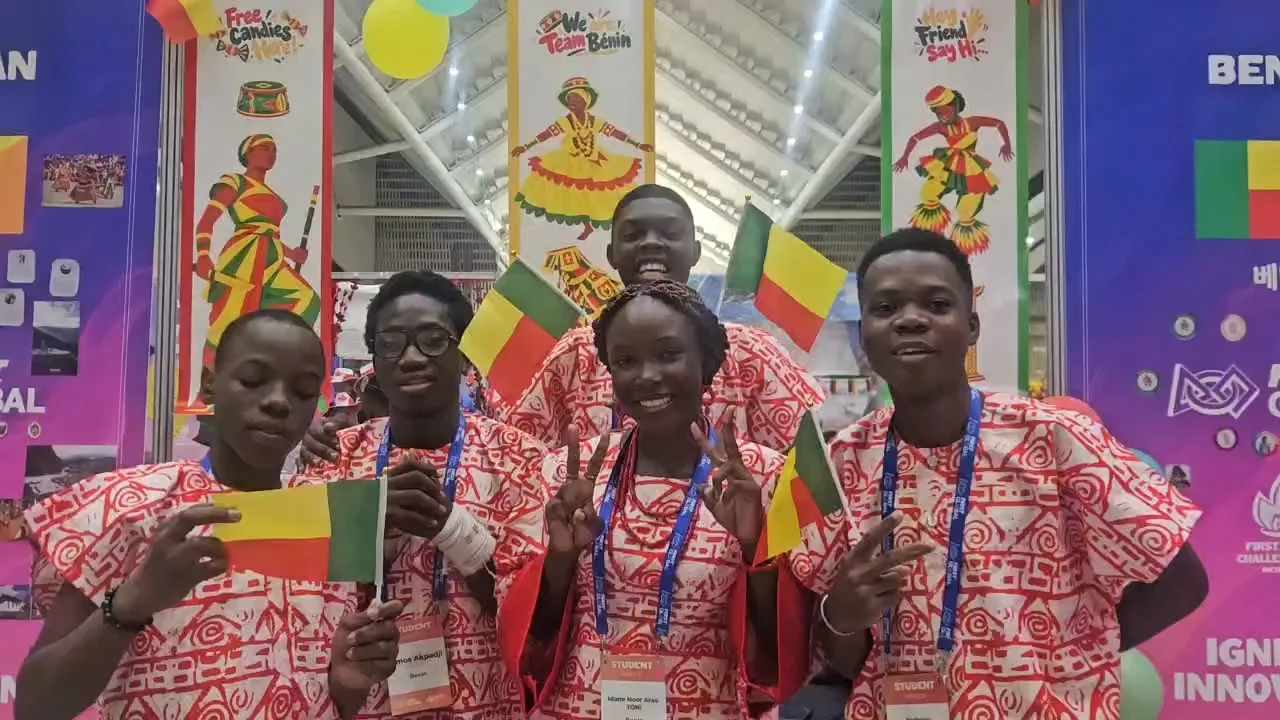
We also wore our country’s colours at the opening ceremony, in traditional outfits alongside teams from around the world. Those moments matter. The competition is an opportunity to introduce Benin, meet other young people and share a culture as well as a technical project.
Our season also included FireWise Benin, a prototype focused on preventing bush fires. Its ambition is to make practical guidance accessible in French, Fongbé, Yorùbá and English, with a design that considers connectivity constraints. It remains a prototype: it extends our thinking about wildfires without being presented as an already validated public service.
We documented the robot’s design in our engineering notebook and shared a free bilingual FGC 2026 kit parts catalogue for other teams. Illustrations, stickers and our mascot inspired by Arsène accompanied the season too. They remind us that this adventure belongs to the whole team, including members who could not travel.
In Incheon, with support from Benin
The journey took more than 17 hours, as we shared in our arrival video. Behind those images and our first days on site was preparation carried out by the young people, femCoders mentors and everyone who helped make the trip possible.
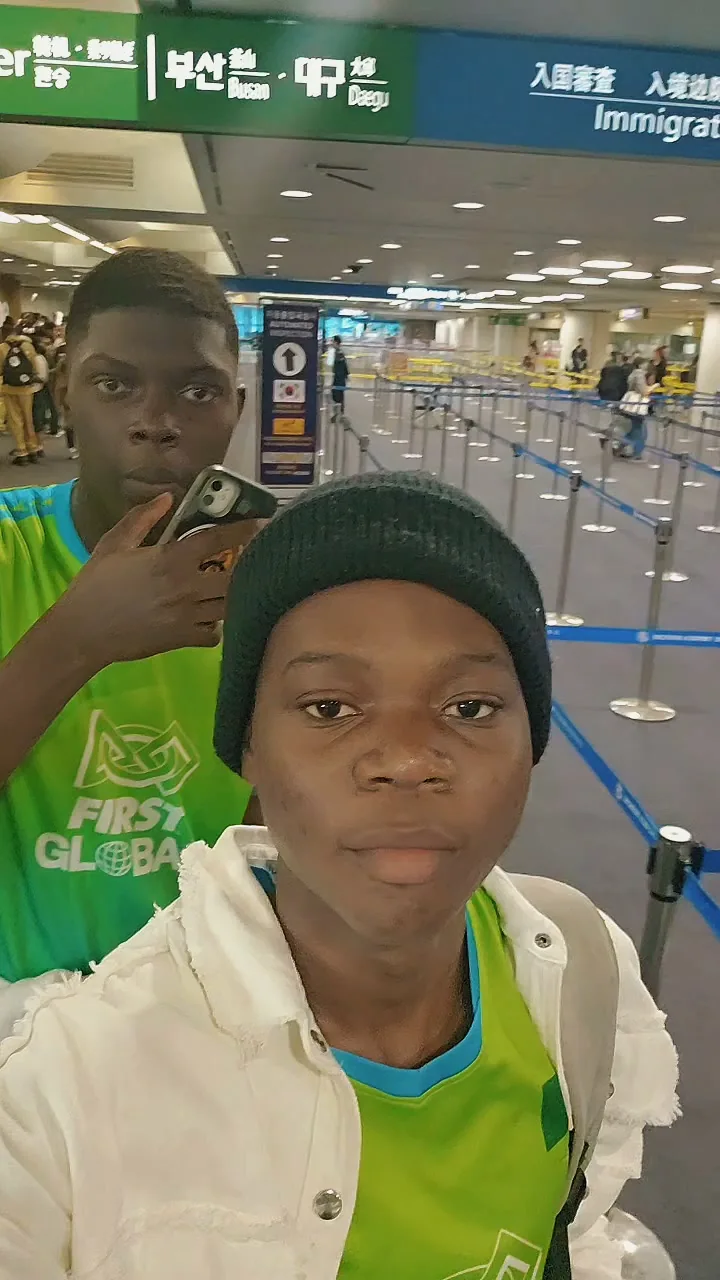
The #HomeTeam Challenge also made the support from home visible. To everyone who encouraged us, to our families, mentors, partners and friends of Team Benin: thank you. Your part in this adventure reached far beyond the distance.

What we take into the next season
We would have liked to finish higher and see our robot hold Zone 3 through the end. We can say that while recognising the work accomplished: eleven matches played, six alliance wins, a climb to Zone 3 and a ranking stage that ended with two victories.
Our next priorities are concrete: make the climb more reliable, improve the consistency of collection and shooting cycles, practise more alongside other robots and prepare our pre-match conversations with alliance partners more thoroughly.
We return with a ranking, but also with a robot we designed, decisions we can explain more clearly and competition situations we experienced together. That experience is what we will build on next.
Thank you for following Team Benin in Incheon. Watch our videos on Team Benin — FIRST Global and follow our training activities on femCoders.