
FireWise Bénin: A Prototype for Preventing Bush Fires
Team Bénin’s FGC 2026 FireWise Bénin project explores practical fire-prevention guidance, hazard awareness and reporting in four languages.
In this article
In the FGC 2026 game, robots fight fires that have already started. They collect WILDFIRE balls and put them in the Suppression Unit. It's fun, it's loud, and it's a great game.
But when we started thinking about real fires in Bénin, one question kept coming back: what if we could act before the fire? Not suppress it. Prevent it.
That question became FireWise Bénin, our FGC 2026 Igniting Innovation prototype. The features described below are design intentions, not a validated public service.
The Problem, Close To Home
During the dry season in Bénin, bush fires are part of the landscape. Many of us have seen them: black fields along the road, smoke on the horizon, the smell in the air.
We focused on common everyday reasons for using fire:
- clear a field for planting,
- burn what's left after the harvest,
- get rid of trash,
- renew pasture for animals.
These activities meet real needs. Our question was how practical information might help people consider alternatives, especially when dry vegetation and wind can allow a fire to spread.
So we focused on the moment before a fire is lit: what information could help someone consider a safer option? That question shaped our app concept.
Three Features We Designed
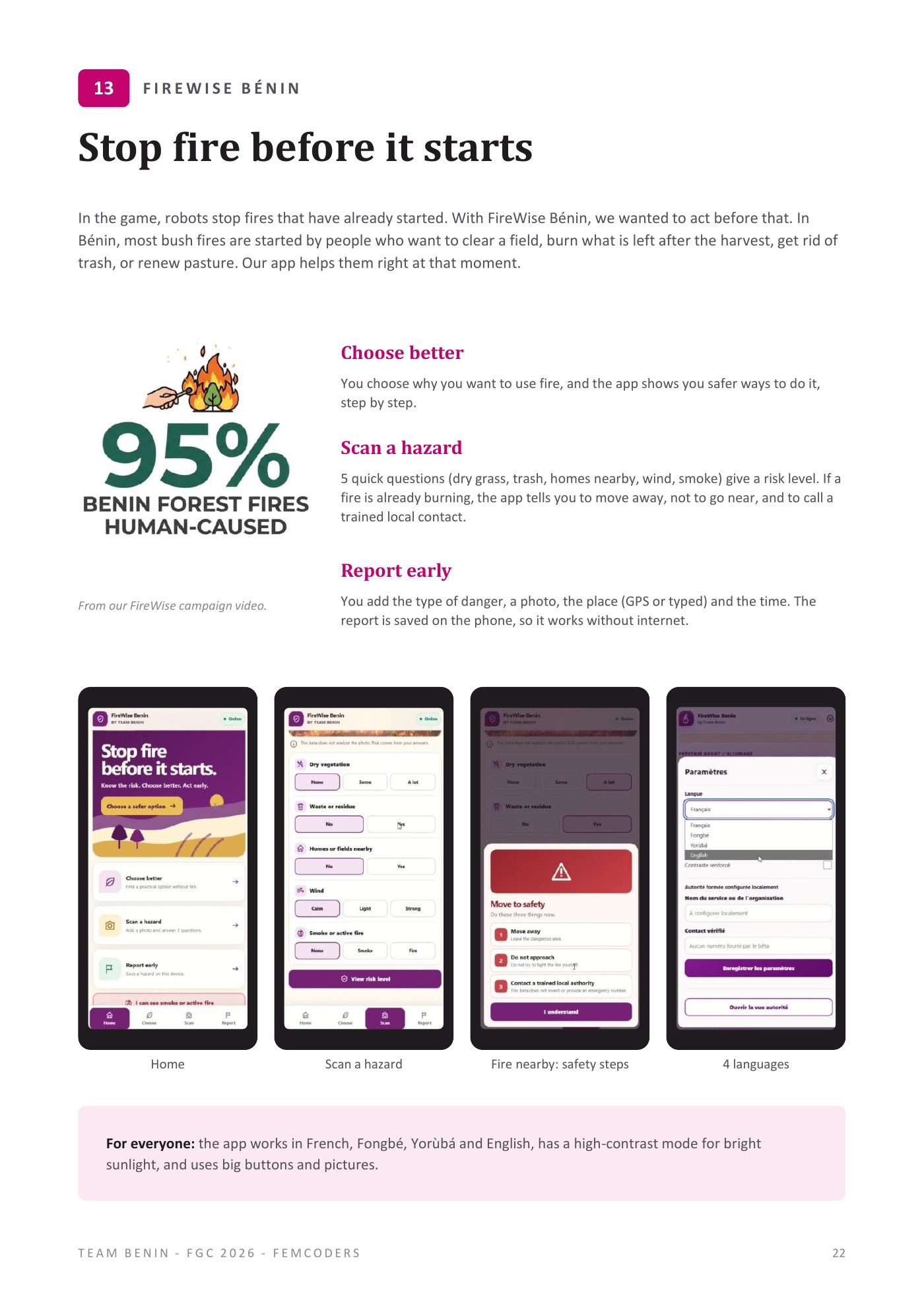
We kept the concept simple, like our robot: three planned features on the home screen.
Choose Better
In the concept, a user chooses why they want to use fire—clearing a field, burning crop residue, disposing of waste or renewing pasture—and receives practical guidance about safer options.
We did not want the concept to simply say “don’t burn.” A person may still need to clear a field. The design starts from that need and aims to offer a practical alternative or safer approach.
Scan A Hazard
Five quick questions:
- Dry vegetation? (none / some / a lot)
- Waste or residue? (no / yes)
- Homes or fields nearby? (no / yes)
- Wind? (calm / light / strong)
- Smoke or active fire? (none / smoke / fire)
In the design, the answers produce a risk level.
If a fire is already burning, the design switches to a safety screen with three clear steps:
- Move away from the dangerous area.
- Do not approach. Don't try to fight the fire yourself.
- Contact a trained local authority.
We were very careful with this part. We are students. We are not firefighters. The screen is designed to direct people toward safety and trained responders, rather than encourage them to approach a fire. Also, the app is honest about its limits: in the beta, it does not analyse photos with AI. The risk level comes from your answers.
Report Early
The proposed report includes:
- the type of danger,
- a photo,
- the place (by GPS or typed by hand),
- the time.
The design calls for reports to be saved on the phone, so the concept can work without an internet connection. That was a must for us. In many rural areas where bush fires start, mobile data is weak or expensive. An app that only works online would fail exactly where it's needed most. Offline use is one of the project’s design goals.
The settings are designed to support a verified local contact and organisation name, once a reporting pathway has been agreed locally.
Designed For Everyone
This is the part we're proudest of. The intended users include people working outdoors, including farmers and herders, with different levels of comfort using a smartphone.
The prototype is designed with those conditions in mind:
Four languages. The prototype is designed for French, Fongbé, Yorùbá and English. French is the official language of Bénin, but in many villages, Fongbé or Yorùbá is what people actually speak at home. A safety app in a language you don't fully understand is not a safety app.
The design includes a high-contrast mode intended to improve readability in bright sunlight.
The design uses large tap targets and icons to reduce reliance on long written instructions.
How It Connects To Our Robot
You might ask: what does a fire-prevention app have to do with a ball-shooting robot?
More than you'd think. We used the same method for both:
- Define the real problem first. (For the robot: what scores? For the app: when do fires start?)
- Do a few things well instead of everything badly. (Robot: collect, store, shoot, climb. App: choose, scan, report.)
- Design for the real conditions. (Robot: 100 mm ball, 50 cm cube, no spare parts. App: no internet, bright sun, four languages.)
- Test, talk, fix.
The robot taught us engineering. FireWise taught us that engineering is for people.
FireWise Bénin has not been validated with communities. Before anyone could rely on it, its advice, local contacts and reporting process would need review with trained local authorities.
Next entry: what we learned this season, written the night before we fly to Korea.
Takeaway For Other Teams
For your innovation project, start from a real moment in a real person's day. Not "fires are bad," but "a farmer is about to light a field." Design for that moment, in that person's language, in their real conditions (sun, no internet, no time). That's where your idea becomes useful.