
What We Learned This Season (Written the Night Before We Fly)
The night before flying to Incheon for FGC 2026, Team Bénin writes down six engineering lessons from the season and the four next steps we'll take in Korea.
In this article
- Lesson 1: Start With The Ball.
- Lesson 2: A Short Path Jams Less.
- Lesson 3: Small Details Matter.
- Lesson 5: Filming Helps Us Get Help.
- Lesson 6: Our Old Ideas Were Useful.
- The Stages Of Our Robot
- Our Next Steps (The Korea To-Do List)
- A Note To The Judges
- A Note To Other Teams
- A Note To Home
- Takeaway For Other Teams
It's the night before we fly. The robot is packed. Our bags are (mostly) packed. Someone has definitely forgotten something, and we'll find out what at the airport.
Before we leave Cotonou, we wanted to sit down and write what this season taught us. Not the polished version. The real one. These are the six lessons we wrote on the last page of our engineering notebook, with the story behind each one.
Lesson 1: Start With The Ball.
The 100 mm foam ball decides the size of every gap and every roller on the robot. Every single one.
We knew this from the start. We even wrote it in our requirements: "every gap in the robot is sized for the ball, not the other way round." But knowing it and doing it are different things. In Version 2, our entry gap wasn't the same everywhere, and balls got stuck. Our flywheel was too close, and balls lost speed. Both problems were, at the end of the day, about not respecting the ball's size precisely enough.
If we had measured everything around the ball from the very first day, we would have saved one rebuild. One whole rebuild. Think about how many hours that is.
For next season: before drawing anything, we'll make a physical gauge the exact size of the game piece and check every gap with it.
Lesson 2: A Short Path Jams Less.
In Version 1, the balls had to climb the whole robot and pass through three mechanisms. Every handover was a chance to jam.
When we put the intake on the floor in Version 2, two great things happened at once: the path became shorter, AND we freed up space for storage. Fewer handovers, fewer jams, more balls. It's rare that one decision fixes two problems, so when it happens, you remember it.
For other teams: draw the full path of your game piece and count the handovers. Each one is a risk. Fewer is better.
Lesson 3: Small Details Matter.
A plastic wall that bends a few millimetres is enough to slow a ball down.
A few millimetres! We could barely see it. We had to be told by two other teams, from another continent, looking at a phone video. And the fix was two rails from the kit.
This lesson made us look at our robot differently. Now when something is "almost right," we don't say "that's fine." We ask: "Is a few millimetres hiding a problem here?"
LESSON 4: PRESSING HARDER DOESN'T SHOOT FASTER.
When our shots were weak, our first thought was "more power." Wrong.
The flywheel was pressing the ball too hard. Too much squeeze doesn't give more speed, it just creates friction. When we moved the flywheel back and gave the ball more space, the shots got better.
The gap is as important as the motor. We think this lesson goes beyond robots, honestly. Sometimes the solution is not to push harder. It's to give things the right amount of space.
Lesson 5: Filming Helps Us Get Help.
Thanks to a short phone video, two other teams understood our robot and helped us in one call.
If we hadn't had the habit of filming every test, we would have had nothing to show. Photos of a robot standing still can't show a ball hesitating at an entry or a shot losing speed. Video can.
Filming is cheap. Every phone does it. It's the most underrated engineering tool we have.
Lesson 6: Our Old Ideas Were Useful.
The flap wheels and the climbing mast on our final robot came from last season's drawings. We didn't start from zero. We adapted old ideas to a new ball and a new game.
That's why we will keep this notebook for next year. Somewhere in these pages, there's a losing idea that might win next season. The "two rows of wheels" shooter, maybe. It lost on motors this year, but it was the most precise.
The Stages Of Our Robot
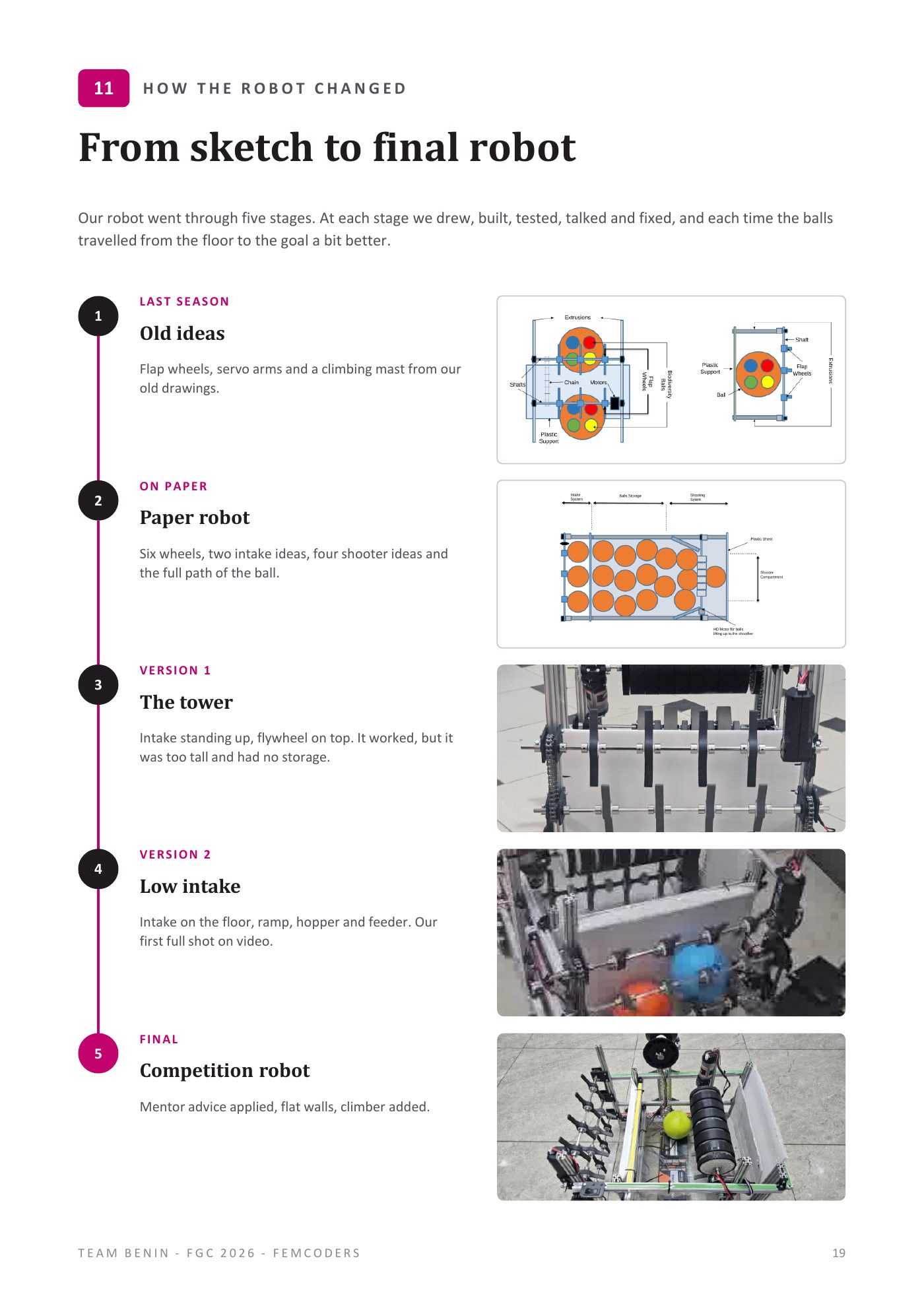
Looking back, our robot went through five stages:
- Last season — old ideas: flap wheels, servo arms, a climbing mast.
- On paper — six wheels, two intake ideas, four shooter ideas, the full path of the ball.
- Version 1 — the tower. It worked, but too tall and no storage.
- Version 2 — low intake, ramp, hopper and feeder. Our first full shot on video.
- Final — mentor advice applied, flat walls, climber added.
At each stage, we drew, built, tested, talked and fixed. And each time, the balls travelled from the floor to the goal a bit better. That's really all engineering is: a bit better, again and again.
Our Next Steps (The Korea To-Do List)
We're not done. These four items are on our list for Incheon, and we'll report back on each one:
- Time our full cycles on carpet, so our match plan is based on real numbers.
- Practise the climb from every side, and check every time that the robot comes off the Brace with the power off.
- Fix the D-pad in our code: right now, up and down both turn the climber the same way. Down should turn it backwards.
- Use two controllers: Melvit drives, and Amos controls the intake, the feeder and the flywheel.
We're putting these in public on purpose. Judges, other teams, our families: you can check if we did them.
A Note To The Judges
We know our robot is not the most complicated one you'll see. We chose that. We decided early to do a few things well rather than everything badly. What we can promise you is that we know why every part is where it is, which ideas failed and why, and how to fix things together. All of it is in our engineering notebook, with the videos, the drawings, the decision matrix, and the mistakes.
A Note To Other Teams
Come say hi. We'll share anything we know: our decision matrix, our code structure, our flywheel trick (RUN_USING_ENCODER, target 2600), our kit parts search tool. We got help from two teams we'd never met. We want to pass that on.
A Note To Home
To our families, femCoders, our mentors Olanikè, Adeyoola, Simon, Claudel and Luz-Clarita, and everyone in Bénin following us: thank you. We're carrying the flag with pride. We'll make you proud. And we'll write every day.
Next stop: Incheon. 🇧🇯✈️🇰🇷
Takeaway For Other Teams
Write down why each design change happened, then carry those notes into the next season. A notebook turns this year’s failed ideas into a head start for the next team.