
2 Minutes 30: Our Match Plan and Drive Team
Team Bénin's FGC 2026 match plan in three phases — the first 20 seconds, shoot and repeat, and the climb — plus how our drive team splits the job.
In this article
Melvit here. I'm 15, I've always loved robots and video games, and in Incheon I'll be holding the controller of a real robot in front of a real crowd. Basically my dream game, but with no restart button.
This entry is from the drive team: me (driver), Amos (co-driver), and Ariel (human player), with Richmond's strategy in the background. We want to show you how we plan to use every second of the 2 minutes 30.
Our Robot, In Numbers
Quick reminder of what we're driving:
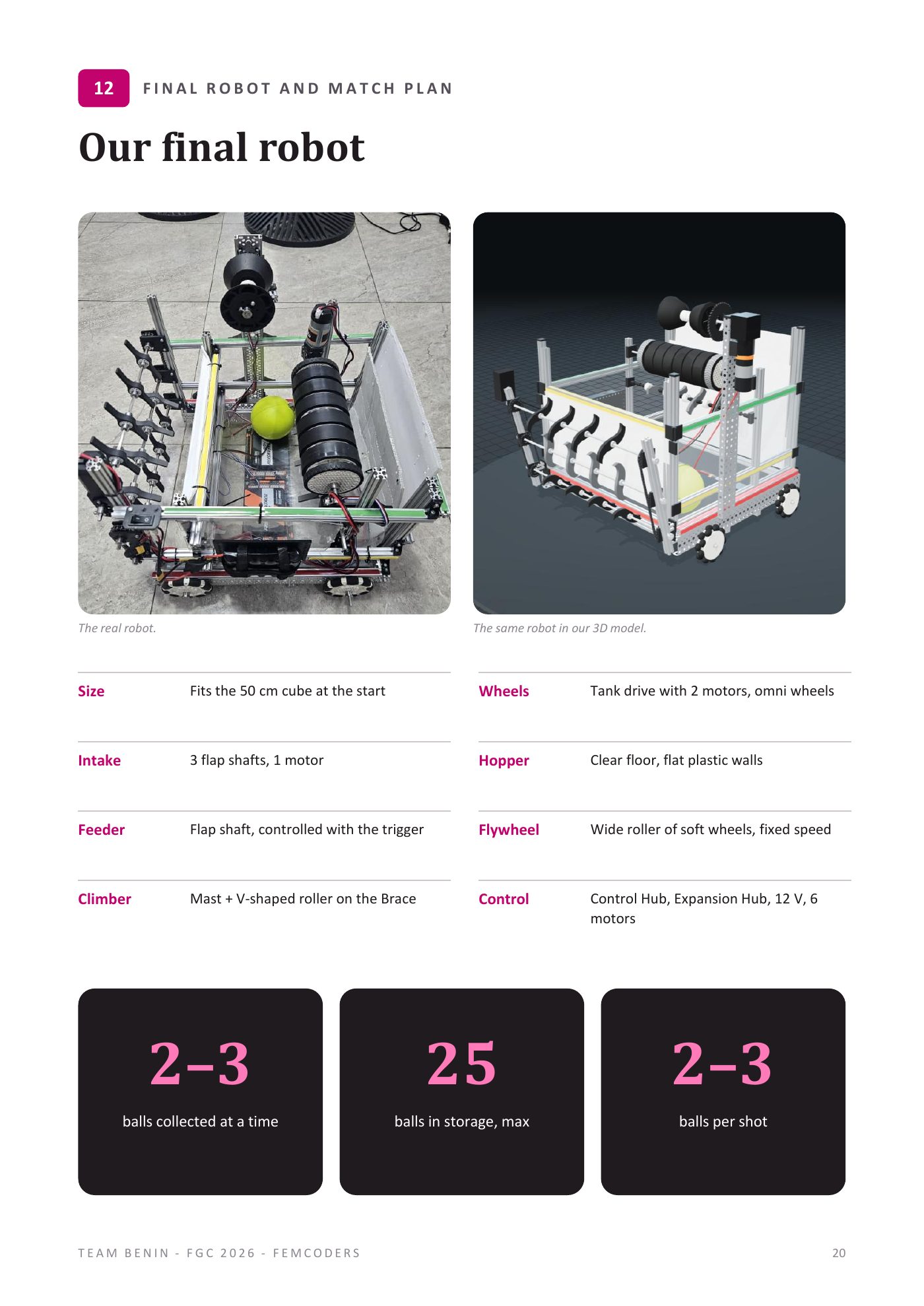
2–3 balls collected at a time 25 balls in storage, max 2–3 balls per shot
Size: fits the 50 cm cube at the start. Wheels: tank drive with 2 motors, omni wheels. Intake: 3 flap shafts, 1 motor. Hopper: clear floor, flat plastic walls. Feeder: flap shaft, controlled with the trigger. Flywheel: wide roller of soft wheels, fixed speed (2600). Climber: mast + V-shaped roller on the Brace. Control: Control Hub, Expansion Hub, 12 V battery, 6 motors.
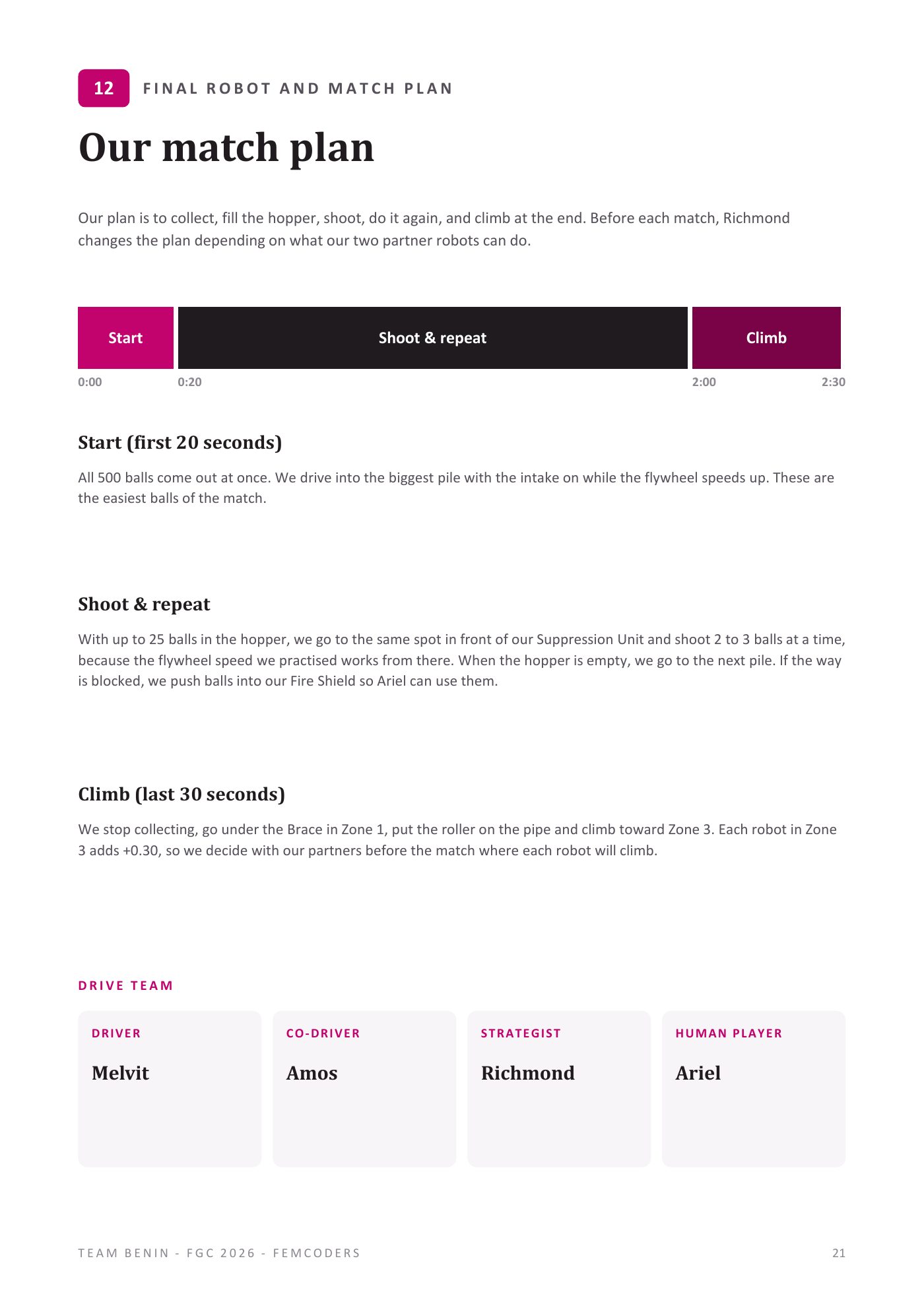
Our plan in one sentence: collect, fill the hopper, shoot, do it again, and climb at the end.
Simple to say. Hard to do while five other robots are moving around you.
Phase 1: The Start (0:00 → 0:20)
At the start of the match, all 500 balls come out at once. This is chaos, but it's good chaos: balls everywhere, in big piles.
What we do:
- I drive straight into the biggest pile with the intake on.
- At the same time, the flywheel starts spinning up to 2600, so it's ready when we arrive at our shooting spot.
These are the easiest balls of the whole match. They're close together, so every pass of the intake catches 2 to 3. Later in the match, balls are spread out and you have to chase them. So in the first 20 seconds, the goal is simple: fill as much of the hopper as possible, as fast as possible.
My personal rule for Phase 1: don't aim. Just drive through the pile. Our intake covers the full 50 cm width exactly so that I don't have to be precise.
Phase 2: Shoot & Repeat (0:20 → 2:00)
This is the main part of the match, and it's a loop:
- With up to 25 balls in the hopper, we go to the same spot in front of our Suppression Unit.
- We shoot 2 to 3 balls at a time.
- When the hopper is empty, we go to the next pile.
- Back to step 1.
Why always the same spot? Because the flywheel speed we practised (2600) works from there. We tested our shot from that position again and again. If I shoot from a random place, I'm gambling. If I shoot from our spot, I'm repeating something we've done many times. In a loud arena with my heart beating fast, I want repetition, not gambling.
And what if the way is blocked? Another robot parked in front of our spot, a traffic jam of robots, no clear path? Then we switch: we push balls into our Fire Shield, so Ariel can use them. The balls are never wasted.
Ariel At The Fire Shield
Ariel's job is underrated, so let's give it some love.
Ariel stands at the Fire Shield as our human player. When we push balls into its Port, Ariel takes them. A lot of balls go through Ariel's hands during a match. That's our backup scoring path: when our robot can't reach the Suppression Unit, the balls still work for us through Ariel.
Ariel loves basketball. Quick hands, good throws, calm under pressure. Exactly what a human player needs.
Phase 3: The Climb (2:00 → 2:30)
In the last 30 seconds, we stop collecting. This is a hard rule, and probably the hardest one to respect, because there are always balls right there begging to be picked up.
What we do:
- Drive under the Brace in Zone 1.
- Put the V-shaped roller on the pipe.
- Climb toward Zone 3.
Remember the math from our strategy entry: each robot in Zone 3 adds +0.30 to the multiplier, and the multiplier works on all the balls we scored before. So by 2:00, every ball we already scored is waiting for the climb to make it worth more.
That's also why we decide with our partners, before the match, where each robot will climb. The Brace has three zones, and three robots from one alliance can't all be in the same place at the same time without a plan. A 30-second argument at the Brace is 30 seconds lost.
Why 30 Seconds?
Why 2:00 and not 2:15? Because the climb is not instant. We need time to drive to the Brace (from wherever we are), line up, place the roller, and climb. And if something goes wrong, we need time to try again. Starting at 2:00 gives us a safety margin.
The 2:00 mark is our planned transition, not a measured competition result. Practice on the event carpet will tell us whether that timing gives enough room.
The Drive Team
Driver — Melvit Co-Driver — Amos Strategist — Richmond Human Player — Ariel
Amos is my co-driver, and Amos's superpower is staying calm when the match goes crazy. When I'm focused on driving, he watches the field, the clock and the other robots, and tells me what's coming. Amos also built the robot by hand, so if something sounds wrong, Amos hears it first.
New for Incheon: we're moving to two controllers. I'll drive with one controller, and Amos will control the intake, the feeder and the flywheel with the other. That way I can focus 100% on driving and positioning, and Amos handles the ball path. Two brains, one robot.
Richmond is our strategist. Before each match, Richmond changes the plan depending on what our two partner robots can do. If a partner shoots really well, maybe we collect and feed. If a partner can't climb, maybe we adjust who goes where on the Brace. The plan above is our default, not a law.
What We Still Need To Do
Two items from our next-steps list are directly about the match:
- Time our full cycles on carpet. Our workshop floor is not the competition carpet. We want to know exactly how long one loop (collect → spot → shoot → back) takes on the real surface, so our plan is based on real numbers, not hopes.
- Practise the climb from every side, and check every time that the robot comes off the Brace with the power off.
We'll report back on both from Korea.
A Message To Our Future Alliance Partners
If we're in your alliance: hello! Come find us before the match. We'll tell you exactly what our robot does well (collecting fast, storing 25, shooting 2 to 3 at once, climbing), and we want to hear what yours does. Then let's agree on who goes where on the Brace. We're good at planning, and we bring stickers.
Next entry: FireWise Bénin, our innovation project. Because in the game, robots stop fires that have already started. We wanted to stop them before.
Takeaway For Other Teams
Pick one shooting spot and practise from it until it's boring. In the arena, boring is beautiful. And set a hard "stop collecting" time for your climb, then respect it, even when there's a ball right in front of you.