
Decoding the Wildfire Game: The Math That Shaped Our Robot
How Team Bénin read the FIRST Global Challenge 2026 Wildfire game manual, did the scoring math, and turned it into five robot priorities and a 50 cm design.
In this article
- The Game In One Paragraph
- The Field, As We See It
- How Points Are Scored
- Insight 1: We Have To Score Before We Climb.
- Insight 2: Moving Many Balls Matters More Than One Perfect Shot.
- Five Jobs, Ranked
- The Numbers That Shaped Our Robot
- The Rules We Had To Respect
- From Rules To A Checklist
- What This Means For Incheon
- Takeaway For Other Teams
Before we touched a single screw this season, we sat down with the FGC 2026 Game Manual, one question: what actually wins points?
This entry is the strategy behind everything. If you are a judge, this is where you'll see why our robot looks the way it does. If you are another team, steal whatever is useful. We're all fighting the same fires.
The Game In One Paragraph
This year the theme is wildfires. Two alliances of three robots play on a 7 × 7 metre field for 2 minutes 30 seconds. At the start, 500 orange balls called WILDFIRE roll out onto the field, and every robot tries to collect them.
Five hundred balls. That number changes everything.
The Field, As We See It
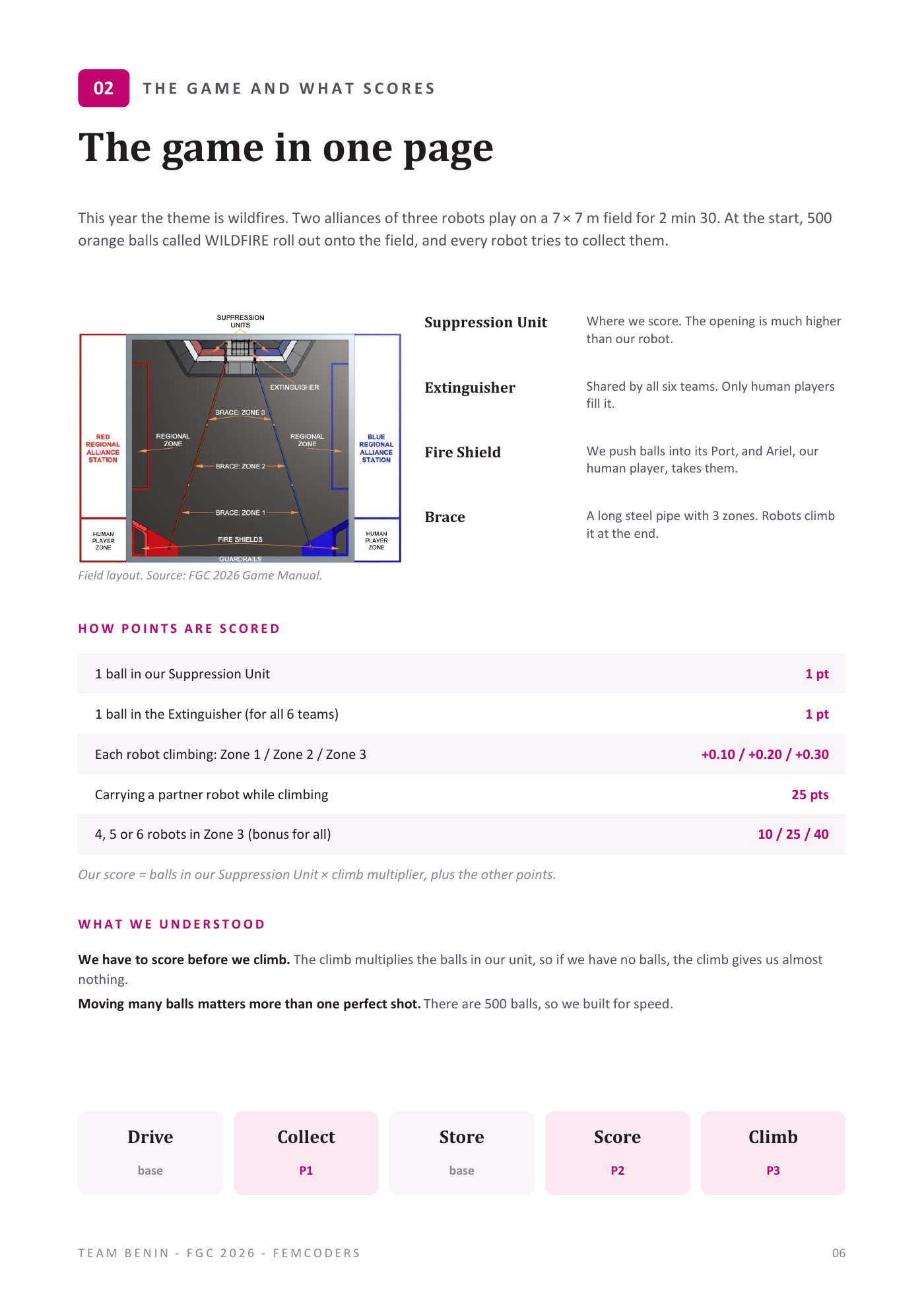
There are four things on the field that matter for us:
The Suppression Unit. This is where we score. The opening is much higher than our robot. Remember that sentence, it changed our whole design.
The Extinguisher. It's shared by all six teams on the field, and only human players can fill it.
The Fire Shield. We push balls into its Port, and Ariel, our human player, takes them from there.
The Brace. A long steel pipe with three zones. Robots climb it at the end of the match.
How Points Are Scored
Here's the scoring, simplified:
- 1 ball in our Suppression Unit = 1 point
- 1 ball in the Extinguisher = 1 point (for all 6 teams)
- Each robot climbing: Zone 1 / Zone 2 / Zone 3 = +0.10 / +0.20 / +0.30 to the multiplier
- Carrying a partner robot while climbing = 25 points
- 4, 5 or 6 robots in Zone 3 = 10 / 25 / 40 bonus points for everyone
And the most important line of all:
Our score = balls in our Suppression Unit × climb multiplier, plus the other points.
THE "AHA" MOMENT
We stared at that formula for a while. Then it clicked: if we have zero balls, climbing is worth zero times something. That was our first big insight.
Insight 1: We Have To Score Before We Climb.
The climb multiplies the balls in our unit. Let's do the math with real numbers to show it:
- 10 balls, robot climbs to Zone 3 (+0.30): 10 × 1.30 = 13 points. The climb added 3.
- 60 balls, same climb: 60 × 1.30 = 78 points. The climb added 18.
Same climb, six times more value, just because we scored more balls first. A climb is a reward for good scoring. It is not a replacement for it. A team that spends the whole match trying to climb beautifully with an empty Suppression Unit basically climbs for nothing.
(Small note for strategy nerds: the climb multiplier is per robot, and it stacks across the alliance. That's why we talk to our partners before every match about who climbs where. More on that in the match plan entry.)
Insight 2: Moving Many Balls Matters More Than One Perfect Shot.
There are 500 balls on the field. Even if our alliance is amazing, we will never run out of balls to score. The limit is not the balls. The limit is time.
So instead of designing a sniper that takes one perfect shot every five seconds, we designed for speed: grab many balls at once, store them, shoot several at once. Quantity, done reliably.
When we explain this to younger members, we say: in a game with 500 balls, the robot that moves the most balls wins, not the robot with the prettiest shot.
Five Jobs, Ranked
From those two insights, we wrote the five jobs our robot must do and ranked them:
DRIVE — base (no robot without it) COLLECT — Priority 1 STORE — base SCORE — Priority 2 CLIMB — Priority 3
Why is Collect above Score? Because you can't score what you didn't collect. And why is Climb last? Because of Insight 1: the climb only multiplies. If we had to choose between a robot that collects and scores well but climbs badly, and a robot that climbs perfectly but collects badly, we choose the first one every time.
This ranking was our compass. Every time we had to choose, for example "do we give this motor to the shooter or to the climber?", we went back to it.
The Numbers That Shaped Our Robot
Then the rules gave us some hard numbers:
50 × 50 × 50 cm. Our robot must fit in a 50 cm cube at the start of the match. After the start, it can extend up to 50 cm more on one side.
100 mm. That's the size of the ball. This became our most important measurement. Every gap in our robot is sized for the ball, not the other way round. If you build first and then hope the ball fits, you'll rebuild. (We know. We'll tell you about it in the "What we learned" entry.)
50 cm wide = 2 to 3 balls. Our robot is 50 cm wide, so a 100 mm ball fits 2 to 3 times across the front at the same time, with room for the frame. That's how we got our intake target: grab 2 to 3 balls at once without careful aiming.
The opening is up high. Our robot can't reach the Suppression Unit opening. So we have to shoot the balls. That's why we have a flywheel. One sentence in the manual, one whole mechanism on the robot.
The Rules We Had To Respect
Kit parts only. Everything comes from the FIRST Global REV kit, and there are no spare parts. Every cut is final. Before cutting any extrusion, we measured twice, drew it, and discussed it as a team. (This is also why we later built a kit parts search tool. Knowing exactly what's in your kit is survival.)
No power needed to free us. Balls and the robot must come off the Brace with the robot switched off. So our climber can't be a mechanism that locks and needs power to release.
One control system. One Control Hub, one Expansion Hub and one 12 V battery. That's it.
From Rules To A Checklist
Here's the part we're most proud of in this phase. For each job, we wrote what the robot must do, and how we would check it with a real test. No "it looks good". Only things we can measure:
DRIVE — Cross the field fast and turn on the spot, even full of balls. Check: timed runs, empty and full.
COLLECT — Grab 2 to 3 balls at a time without careful aiming. Check: drive through balls, count caught and missed.
STORE — Hold up to 25 balls without jamming. Check: fill it up, drive around, see if anything gets stuck.
SCORE — Shoot 2 to 3 balls at once into the opening. Check: shoot many times from the same spot.
CLIMB — Hang on the Brace, Zone 1 or higher. Check: climb test, then free it with the power off.
SIZE — Fit in the 50 cm cube at the start. Check: measure it in a 50 cm box.
This table turned arguments into experiments. When two of us disagreed about an idea, we didn't fight. We asked: "Which test would prove it?" Then we ran the test and looked at the video together.
What This Means For Incheon
Strategy on paper is easy. On the real field, with five other robots, noise, and a clock, it's a different story. We know our plan will change after our first practice match. That's fine. The two insights won't change:
- Score first, then climb.
- Move lots of balls, not one perfect ball.
Next entry: the paper robot. Sketches, four shooter ideas, and the decision matrix that killed our favourite idea.
Takeaway For Other Teams
Write the scoring formula on a big sheet and stick it on the wall of your workshop. Then plug in real numbers (10 balls, 30 balls, 60 balls) and see what each action is actually worth. You'll find out quickly which mechanism deserves your best motor.