
Meet Team Bénin: Ten of Us, One Robot, One App
Team Bénin (Équipe du Bénin) introduces its ten members, its femCoders mentors and the five-step method behind its FIRST Global Challenge 2026 robot.
In this article
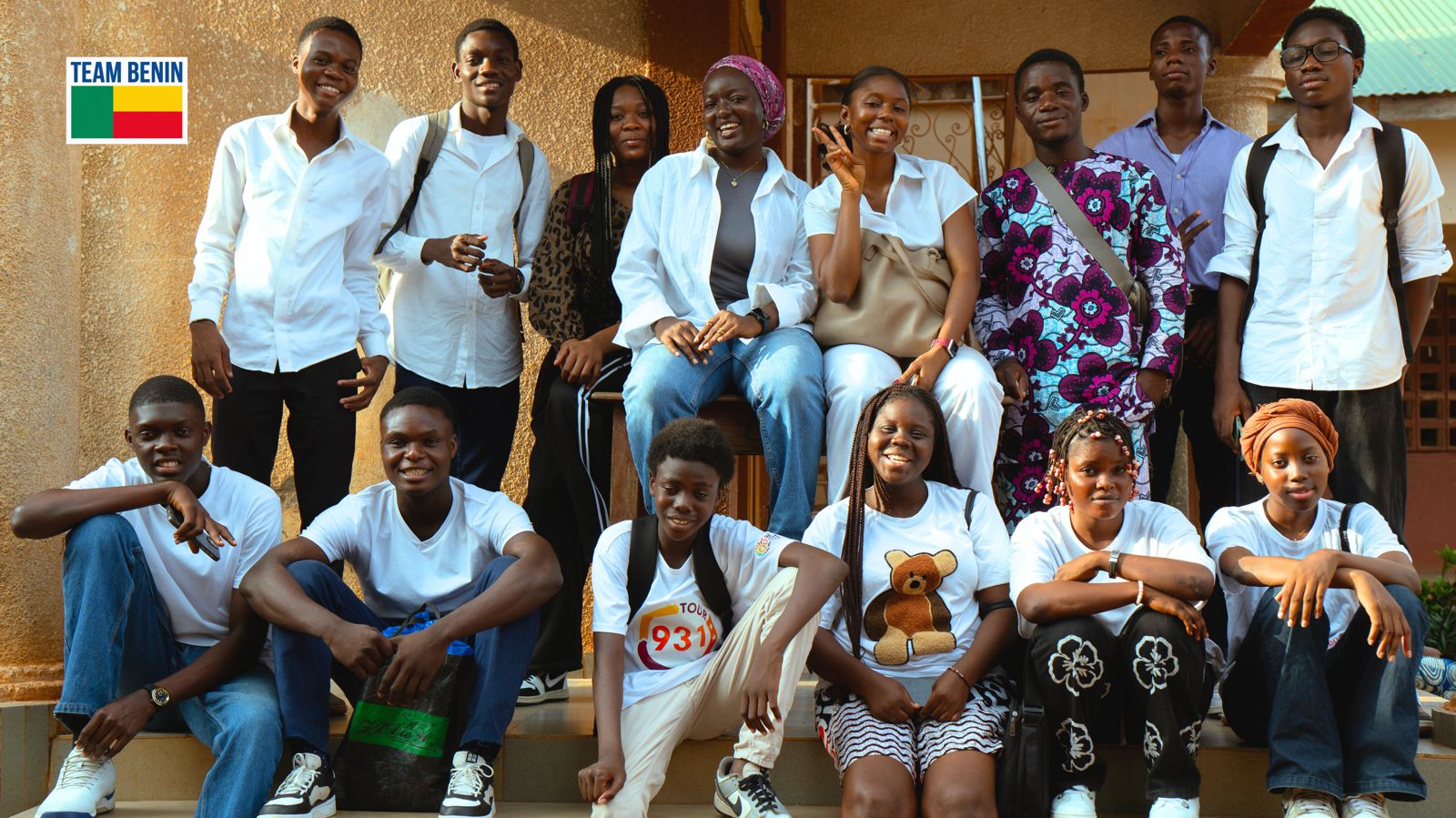
Tomorrow we fly to Incheon, South Korea, for the FIRST Global Challenge 2026. Tonight, our bags are half packed, the robot is wrapped like a newborn, and somebody is definitely asking if we can take one more test video "just to be sure."
So before the adventure starts, we want to introduce ourselves properly. This is the first entry of our travel journal. We're writing it for our families back home in Bénin, for the judges who will read our work, and for every other team at FGC 2026 who wants to know who those people in green, yellow and red are.
Who We Are
We are Team Bénin. Ten young people, from 7 to 18 years old, trained and mentored by femCoders in Cotonou. This season we built two things:
- A robot for the FIRST Global Challenge 2026, whose theme this year is wildfires.
- FireWise Bénin, an app prototype exploring ways to prevent bush fires before they start.
Ten people, two projects, one season. It sounds like a lot. It was a lot. But we decided very early on a rule that saved us many times: we would rather do a few things well than everything badly. That rule shaped our robot, our app, and honestly the way we talk to each other.
Meet The Crew
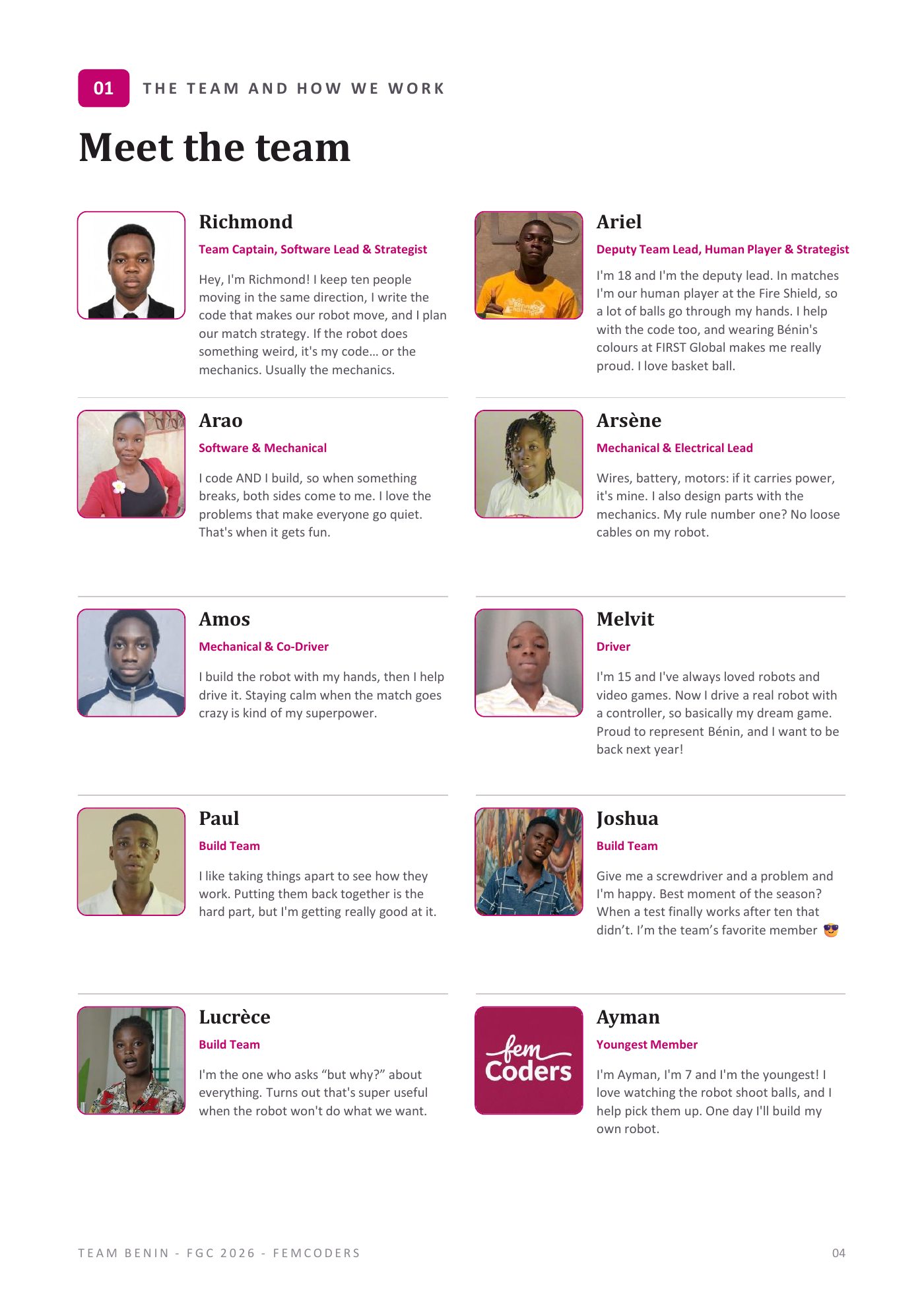
Richmond — Team Captain, Software Lead and Strategist. That's me. I keep ten people moving in the same direction, I write the code that makes the robot move, and I plan our match strategy. If the robot does something weird, it's my code... or the mechanics. Usually the mechanics.
Ariel — Deputy Team Lead, Human Player and Strategist. Ariel is 18 and plays human player at the Fire Shield, which means a huge number of balls go through Ariel's hands during a match. Ariel helps with the code too, and loves basketball, which is very useful when your job is to throw balls quickly and accurately. Wearing Bénin's colours at FIRST Global? Ariel calls it a real source of pride. Same.
Arao — Software and Mechanical. Arao codes AND builds, so when something breaks, both sides come to Arao. Arao loves the problems that make everyone go quiet. That silence in the workshop when nobody knows why the intake stopped? That's Arao's favourite sound.
Arsène — Mechanical and Electrical Lead. Wires, battery, motors: if it carries power, it belongs to Arsène. Rule number one: no loose cables on the robot.
Amos — Mechanical and Co-Driver. Amos builds the robot with his hands, then helps drive it. His superpower is staying calm when the match goes crazy. We will need that superpower in Korea.
Melvit — Driver. Melvit is 15 and has always loved robots and video games. Now he drives a real robot with a controller, so basically his dream game came true. He already wants to come back next year, and we haven't even left yet.
Paul — Build Team. Paul likes taking things apart to see how they work. Putting them back together is the hard part, but he's getting really good at it.
Joshua — Build Team. Give Joshua a screwdriver and a problem, and he's happy. His best moment of the season: when a test finally works after ten that didn't. He also describes himself as the team's favourite member. Nobody voted on this.
Lucrèce — Build Team. Lucrèce is the one who asks "but why?" about everything. At first it can be annoying. Then you realise it's the most useful question in engineering, especially when the robot refuses to do what you want.
Ayman — Youngest Member. Ayman is 7. He loves watching the robot shoot balls and he helps pick them up (there are a LOT of balls). One day, he says, he'll build his own robot. We believe him.
The People Behind Us
Nobody does this alone. Our mentors at femCoders are a big reason we got this far.
Olanikè, Co-Mentor and Technical Mentor. She guides us through the construction of the robot, the 3D model, our tests and the engineering notebook. She is calm, creative and super smart. She has been with femCoders since 2017 and was already with Team Bénin at FGC 2019, so she knows what's waiting for us.
Adeyoola, Mentor for Season Coordination. A ball of energy and happiness, and it's contagious. She organises everything: activities, communication, preparation for the competition, and making sure each of us is doing okay. When things get blurry and stressful, she's the one who helps us find the way.
Simon, Mentor. Our saviour for robot architecture and programming. When something isn't working, he can tell us why in a few seconds. He was a Team Bénin member himself and a 2025 mentor. We all want to be like Mr. Simon, ha ha.
Claudel, Mentor. He knows almost everything. With his magic hands, he can craft or build anything we imagine. He's an expert at cutting extrusions and making the systems we struggle with work perfectly.
Luz-Clarita, Assistant Mentor. She follows our work and helps us write down our methods and decisions in the notebook.
Four Small Teams Inside One Big Team
Ten people working on the same robot at the same time is chaos. So we split into four small teams:
- Mechanical: Amos, Arao, Arsène
- Electrical: Arsène
- Software: Richmond, Arao, Ariel
- Strategy: Richmond, Ariel
The build team (Paul, Joshua, Lucrèce) and Ayman jump in wherever hands are needed. You'll notice some names appear twice. That's on purpose. When Arao is on both software and mechanical, nobody can say "that's not my problem" anymore. The problem belongs to whoever is standing next to it.
How We Work: Five Steps, On Repeat
If you only remember one thing from this post, remember this loop. We repeated it for every single part of the robot:
- DRAW — Sketch the idea and name every part. Not "a wheel", but the exact kit part.
- BUILD — Make it with parts from the kit.
- TEST — Try it with real balls and film it.
- TALK — Watch the video together and ask our mentors.
- FIX — Change one thing, then test again.
Then back to step 1.
And four rules we always try to follow:
- We film every test.
- We change only one thing at a time.
- We decide together, by looking at what the test showed (not at who talks the loudest).
- We write it down the same day.
That last one sounds boring. It is the reason our engineering notebook exists. When you write things down the same day, you remember the real reason you made a decision, not the version you invent two weeks later to sound smart.
Filming every test also turned out to be our secret weapon. A short phone video let two experienced teams on the other side of the world understand our robot in one video call and help us fix three problems. We'll tell that story in a later entry.
Why This Matters To Us
We are going to stand on a field next to teams from all over the world, with a robot we built from a kit in a workshop in Cotonou. We know we are not the biggest team or the one with the most resources. But we know why every part of our robot is where it is, which ideas failed and why, and how to fix things together. That is what we are bringing to Incheon.
We know we are not the biggest team or the one with the most resources. But we know exactly why every part of our robot is where it is. We know which ideas failed and why. And we know how to fix things together, fast. That's what we're bringing to Incheon.
WHAT'S COMING IN THIS JOURNAL
Over the next days, we'll share:
- How we decoded the Wildfire game and the math behind our strategy
- Our sketches, our decision matrix, and the ideas that lost
- Version 1 (the tower) and Version 2 (much better)
- The video call that fixed three problems at once
- Our code, our wiring, and why the number 2600 matters so much
- Our match plan for 2 minutes 30
- FireWise Bénin, our innovation project
- A free tool we built for every FGC 2026 team
- And of course, our stand and our stickers. Come find us. We have stickers.
Then the real trip: the flight, the venue, inspection, matches, alliances, food, and everything that goes wrong (because something always goes wrong).
See you in Incheon. 🇧🇯
Takeaway For Other Teams
Put people on two small teams on purpose. The overlap is where the communication happens. And film everything, even the tests that fail. Especially the tests that fail.