
Paper Robot: Our Sketches, Four Shooter Ideas and the Decision Matrix
Team Bénin shows its FGC 2026 design sketches, two intake ideas, four shooter ideas and the weighted decision matrix that picked a flap-wheel intake and one wide flywheel.
In this article
Here is a confession: before we cut anything, we drew. A lot.
For the people on our team who love screwdrivers, that was painful. But with a kit that has no spare parts, cutting the wrong extrusion is not a small mistake. It's a permanent one. So the rule was: draw before you build.
Rule: Name Every Part
Our drawings weren't just pretty boxes. On each sketch, we wrote the exact name of the kit part we'd use: "HD Motor with Gearbox", "C Channel Extrusion", "Omni Wheel", "Chained sprockets". This had a huge side effect: it let us count. If the drawing needs eight of a part and the kit has six, we found out on paper, not halfway through the build.
Drivetrain: Six Wheels
Our first drawings were for the drivetrain: six wheels. We put grip wheels to push through the balls and through other robots, and omni wheels to turn easily on the spot.
We drew two versions: one with a chain linking the wheels, one without. Why? To compare the number of parts each one needed. Same robot, two drawings, and we could decide by counting instead of guessing.
Intake: Two Ways To Grab A Ball
Idea 1: flap wheels. Rubber flaps mounted on three shafts hit the ball and pull it in. The flaps bend around the ball instead of squashing it. Simple, strong.
Idea 2: elastic strings. Elastic strings stretched between rollers wrap around the ball. It's very soft on the ball, which we liked. But there are a lot of parts that can slip.
THE BALL'S JOURNEY
Then we did something that turned out to be one of our best decisions: we drew the entire path of a single ball, from the floor to the goal.
Top view: intake → storage → shooter. Side view: the ball goes up a ramp and gets lifted to the shooter.
Why bother? Because every place where the ball changes direction, changes speed, or touches a new mechanism is a place where it can get stuck. Drawing the path made those places visible. We circled each one and asked: "What happens if a ball stops here?"
Spoiler: in Version 1 we still built a path that was too long. But at least we knew exactly where the problems were when they appeared.
Four Shooter Ideas
The shooter got the most drawings, because the Suppression Unit opening is higher than our robot and we have to throw the ball. We came up with four ideas:
A. Two rows of wheels. Two stacks of spinning wheels, one above the other. B. Flaps feed one wheel. Flap shafts push the ball up into a single shooting wheel. C. Speed-up gears. Gears that multiply the motor's speed before the wheel. D. Servo gate. A servo holds the ball and releases it into the wheels.
All four use the same basic physics: a fast spinning wheel that squeezes the soft ball and throws it. They differ in how the ball reaches the wheel, and in how many motors they need. And motors, it turns out, were going to be our most precious resource.
WE DIDN'T START FROM ZERO
Something we're proud of: we reused our past. Our drawings from last season already had flap wheels to grab balls, servo arms to hold them, and a mast to climb. We adapted them to this year's 100 mm ball and used them again. That's why we will keep this year's notebook for next year too. Your old notebook is free engineering time.
The Decision Matrix (Where Favourite Ideas Go To Die)
OK, now we had lots of ideas and ten opinions. How do you pick without the loudest person winning?
A decision matrix. Here's how ours works:
- List the criteria that matter.
- Give each idea a score from 1 (bad) to 5 (very good) for each criterion.
- Multiply each score by how important that criterion is for us (its weight).
- Add everything up. Highest total wins.
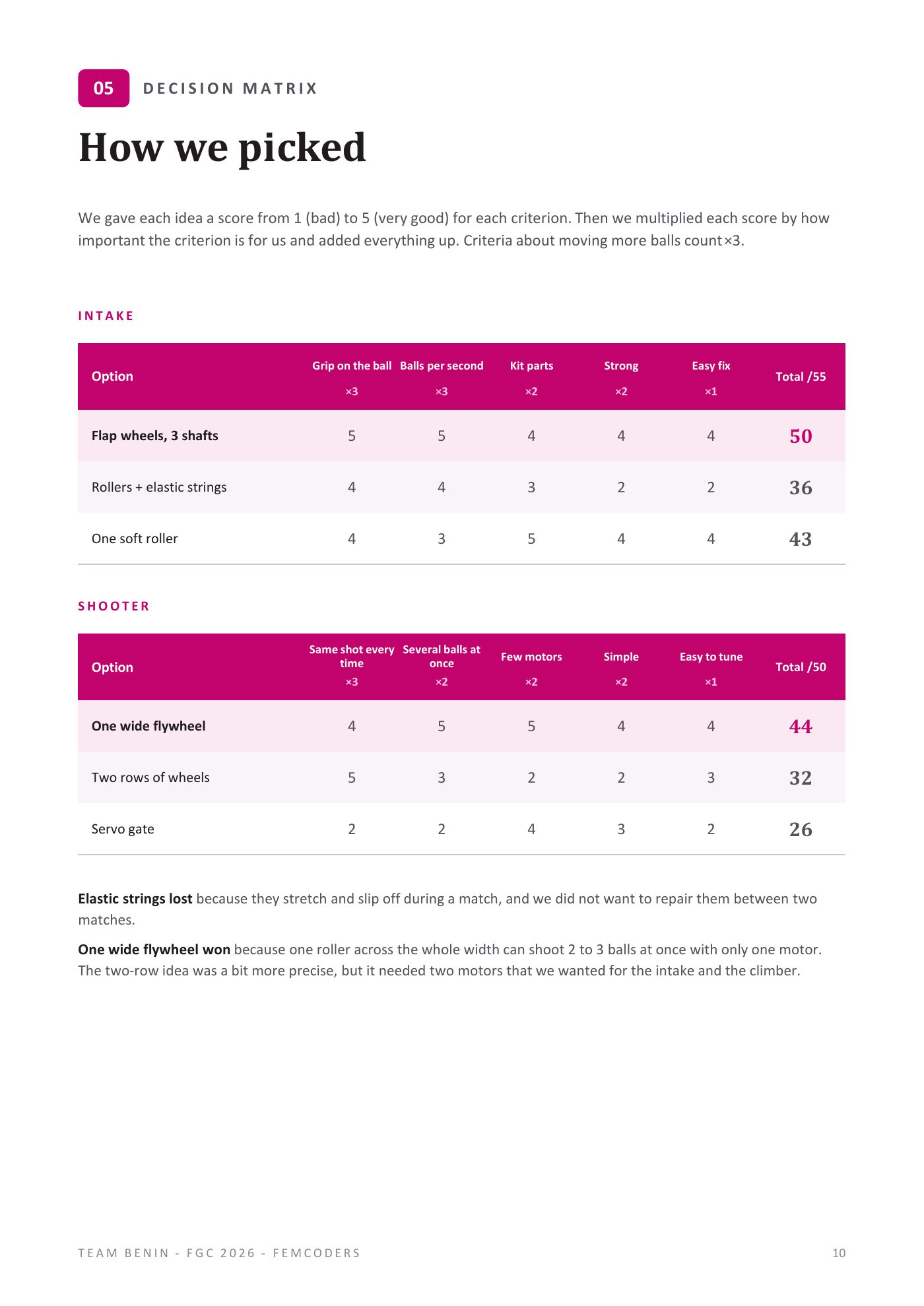
The key choice is the weights. Remember our strategy insight from Part 2: moving lots of balls matters most. So criteria about moving more balls count ×3. That way the matrix thinks like our strategy.
THE INTAKE MATRIX (out of 55)
Criteria and weights: Grip on the ball ×3, Balls per second ×3, Kit parts ×2, Strong ×2, Easy fix ×1.
Flap wheels, 3 shafts: 5, 5, 4, 4, 4 → 50 Rollers + elastic strings: 4, 4, 3, 2, 2 → 36 One soft roller: 4, 3, 5, 4, 4 → 43
Flap wheels win clearly. The elastic strings lost badly on "Strong" and "Easy fix", and here's the honest reason: elastic strings stretch and slip off during a match. We did not want to be repairing strings between two matches with only a few minutes on the clock.
Interesting detail: the "one soft roller" scored the best on Kit parts (5). It's the simplest. But it lost on balls per second, and balls per second counts ×3. That's the matrix doing its job.
THE SHOOTER MATRIX (out of 50)
Criteria and weights: Same shot every time ×3, Several balls at once ×2, Few motors ×2, Simple ×2, Easy to tune ×1.
One wide flywheel: 4, 5, 5, 4, 4 → 44 Two rows of wheels: 5, 3, 2, 2, 3 → 32 Servo gate: 2, 2, 4, 3, 2 → 26
The one wide flywheel won. One roller across the whole width of the robot can shoot 2 to 3 balls at once with only one motor.
Here's the painful part. "Two rows of wheels" got a 5 on "Same shot every time". It was a bit more precise than our winner. But it needed two motors, and we wanted those motors for the intake and the climber. Precision lost to motors. That's a real trade-off, and we're glad we made it with numbers instead of feelings.
Our Chosen Design
When we put the winning ideas together, we got one simple path for the balls, plus a separate climber. The whole robot uses six motors. Here's the line-up, with the name each motor has in our code:
- Intake — 3 shafts of flaps, 2 to 3 balls at a time. Code name: collector
- Hopper — stores up to 25 balls. (No motor. Gravity is free.)
- Feeder — flaps under the flywheel push balls up. Code name: shooterDown
- Flywheel — wide roller, shoots 2 to 3 balls at once. Code name: shooterUp
- Climber — mast + V-shaped roller that rides the Brace. Code name: climbing
Plus leftDrive and rightDrive for the wheels. Six motors, five jobs, one path.
We modelled it in 3D before building, so we could see it from every side and check it fits in the 50 cm cube. (That 3D model is also on the cover of our notebook, with our illustrated mascot pointing at the ball.)
What The Matrix Taught Us
It's not magic. You still choose the scores, and you can cheat if you want to. But it forces two good things:
- Everyone has to explain their score out loud. "Why did you give elastic strings a 2 for Strong?" "Because they slip off, I saw it on the video." Now the decision is based on evidence.
- The weights connect every small choice back to the strategy. Our ×3 on "moving balls" meant that, deep down, every part of the robot was voting for speed.
Next entry: we finally build. Version 1 was a tower, and it taught us more by almost working than it would have by working perfectly.
Takeaway For Other Teams
Put your strategy into the weights of your decision matrix. If your game rewards quantity, weight speed ×3. If it rewards precision, weight accuracy ×3. And keep the losing ideas in your notebook: next season, one of them might be the winner.