
Version 1 Was a Tower. Version 2 Got Low.
Team Bénin's FGC 2026 prototypes: why the Version 1 tower almost worked, what the feeder tests proved, and what the Version 2 test video showed frame by frame.
In this article
This is the build team's entry. Paul takes things apart, Joshua puts screws in things, and Lucrèce asks "but why?" until we have a good answer. Together, we built two robots this season before the final one. Here's the story of both, including the parts that didn't work. Especially the parts that didn't work.
Version 1: The Tower
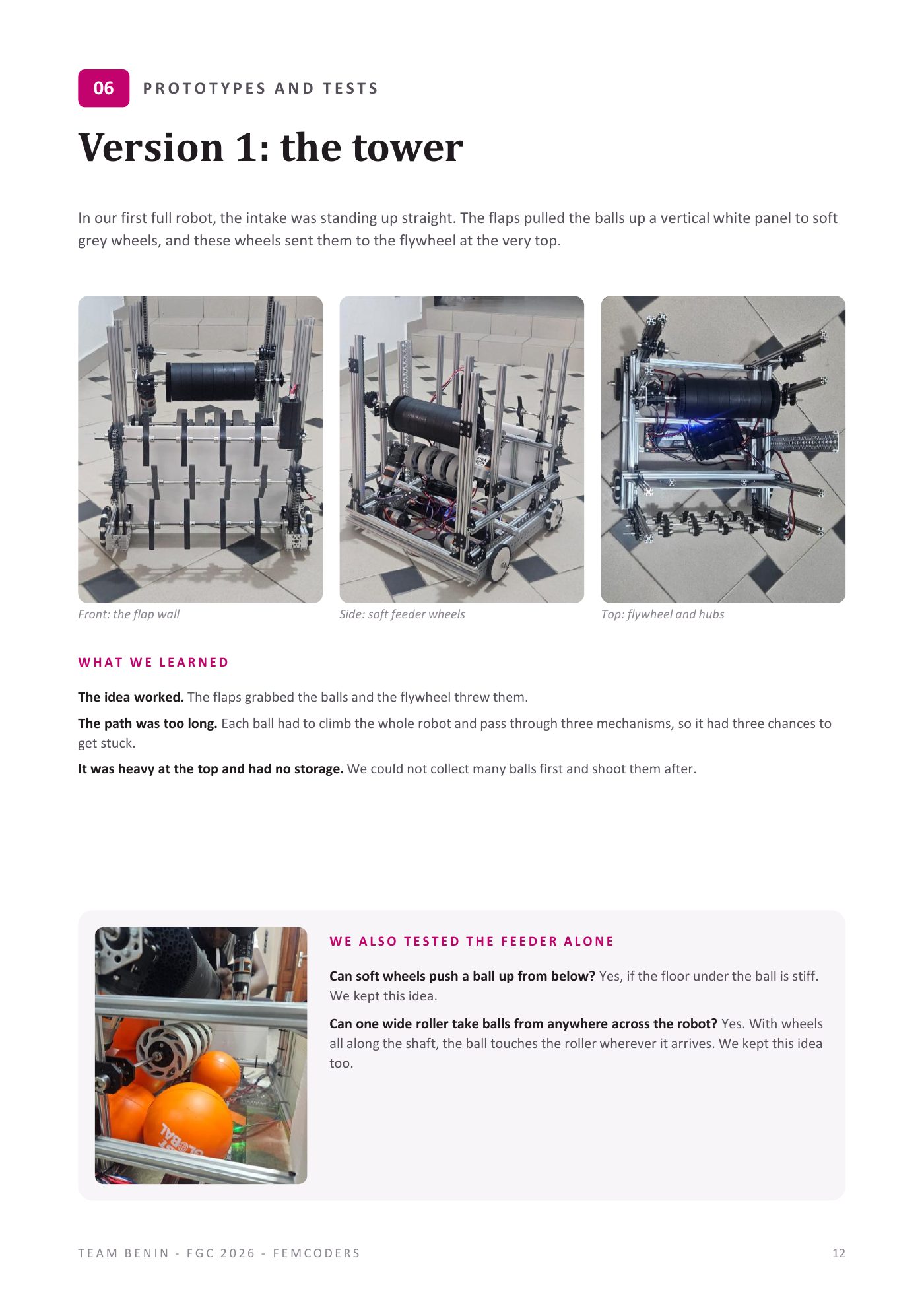
In our first full robot, the intake was standing up straight, like a wall.
Here's how a ball travelled through Version 1:
- The flaps grabbed the ball at the bottom.
- They pulled it up a vertical white panel.
- At the top of the panel, soft grey wheels took the ball.
- These wheels sent it to the flywheel at the very top of the robot.
- The flywheel threw it.
It looked impressive. Tall, lots of moving parts, a big black flywheel on top.
And here's the surprise: the idea worked. The flaps grabbed the balls. The flywheel threw them. The physics was right.
So why isn't Version 1 going to Korea?
What Version 1 Taught Us
We watched the test videos again and again, asking "but why?" (Lucrèce's favourite question), and three problems came out.
Problem 1: The path was too long. Each ball had to climb the entire height of the robot and pass through three different mechanisms: flaps, then grey wheels, then flywheel. Every handover between two mechanisms is a chance for the ball to get stuck. Three mechanisms = three chances to get stuck. In a game where speed is everything, three chances is three too many.
Problem 2: It was heavy at the top. The flywheel and its motor sat high up. A top-heavy robot is a robot that wants to fall over, especially when it turns fast or gets pushed by another robot.
Problem 3: No storage. This was the biggest one. In Version 1, a ball went in and had to go straight out. We could not collect many balls first and shoot them all later. But remember our strategy: grab lots of balls, then shoot lots of balls. Version 1 couldn't do the "lots" part.
In short: it works, but it works one ball at a time.
The Feeder Experiments
Before throwing everything away, we did something smart. We took out one mechanism at a time and tested it alone, to find out which ideas from Version 1 were worth keeping.
We asked two specific questions:
Question 1: Can soft wheels push a ball up from below? Answer: Yes, but only if the floor under the ball is stiff. If the floor bends, the ball sinks and the wheel just rubs it. With a stiff floor, the soft wheel grabs the ball and pushes it up. Decision: we kept this idea. It became our feeder.
Question 2: Can one wide roller take balls from anywhere across the robot? Answer: Yes. With wheels all along the shaft, the ball touches the roller wherever it arrives, left, middle or right. No need to guide the ball to one exact spot. Decision: we kept this idea too. It became our flywheel design.
This is a lesson we want to shout to every team: a "failed" robot is full of good parts. Don't throw it away. Test its pieces one by one and keep the winners.
Version 2: Getting Low
With everything we learned, we redesigned. Version 2 changed three big things:
- The intake went down along the floor instead of standing up.
- We added a sloped panel that leads into a hopper (finally, storage!).
- We placed the feeder under the flywheel, using what we learned from the experiments.
So the new ball path became: floor → flaps → slope → hopper → feeder → flywheel. Shorter, lower, and with a place to keep balls.
Then we did what we always do. We filmed a test with practice balls.
The Test Video, Frame By Frame
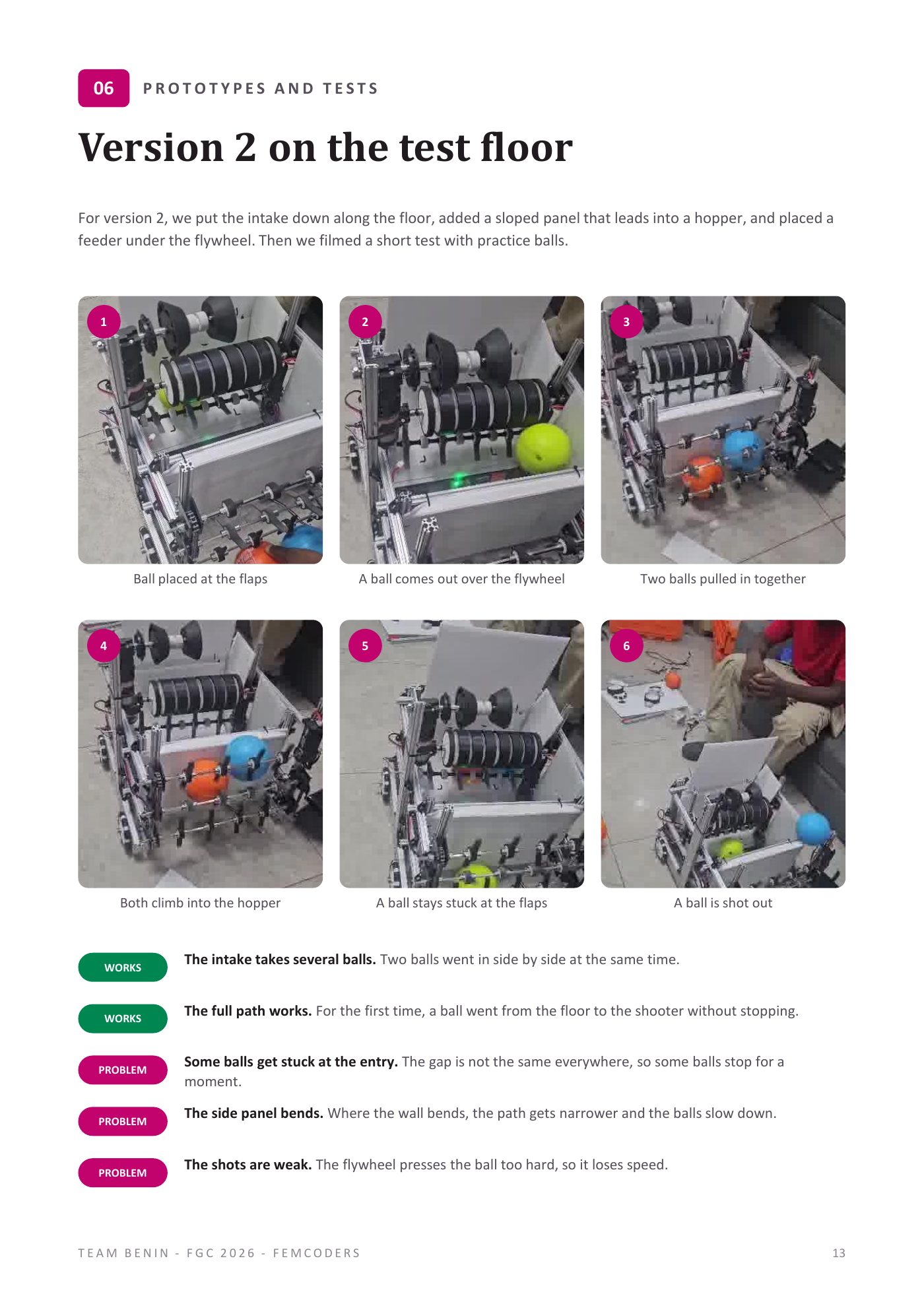
We took six frames from that video for the notebook. Here's what each one shows:
Frame 1: A ball is placed at the flaps. Frame 2: A ball comes out over the flywheel. Frame 3: Two balls are pulled in together. Frame 4: Both balls climb into the hopper. Frame 5: A ball stays stuck at the flaps. Frame 6: A ball is shot out.
Watching it together was a mix of joy and pain, sometimes within the same three seconds.
What Worked
The intake takes several balls. In frame 3, two balls went in side by side at the same time. That's our "2 to 3 balls without careful aiming" target starting to come true.
The full path works. For the first time, a ball went all the way from the floor to the shooter without stopping. This is exactly what Joshua means when he says his favourite moment is "when a test finally works after ten that didn't."
WHAT DIDN'T
Some balls get stuck at the entry (frame 5). The gap between the flaps and the frame is not the same everywhere, so some balls stop for a moment. A moment doesn't sound like much, but in a 2:30 match, moments add up.
The side panel bends. Where the plastic wall bends inward, the path gets narrower and the balls slow down. We almost didn't notice this, because we were so used to looking at our robot.
The shots are weak. The flywheel presses the ball too hard, so the ball loses speed. Our first instinct was "we need more power!" Spoiler: we didn't need more power. We needed more space. More on that in the next entry.
WHY WE'RE SHARING OUR PROBLEMS PUBLICLY
Some teams only show their final robot. We understand why: it's the pretty one. But the judges want to see the process, and other teams can learn more from our frame 5 than from our perfect photos.
Also, three problems from one test is actually great news. It means the test was good enough to find them. A test that only shows success is usually a test that wasn't hard enough.
Our Robot, Stage By Stage
To keep track, we now describe our robot's life in five stages:
- Last season — old ideas: flap wheels, servo arms, a climbing mast.
- On paper — six wheels, two intake ideas, four shooter ideas, the full ball path.
- Version 1 — the tower. Worked, but too tall and no storage.
- Version 2 — low intake, ramp, hopper and feeder. Our first full shot on video.
- Final — mentor advice applied, flat walls, climber added.
Each stage followed the same loop: draw, build, test, talk, fix. And each time, the balls travelled from the floor to the goal a little bit better.
Next entry: the video call that fixed our three Version 2 problems. Two experienced teams, one marked-up photo, and a lesson about seeing your own robot with fresh eyes.
Takeaway For Other Teams
When a prototype disappoints you, don't rebuild everything. Pull out each mechanism and test it alone with one clear yes/no question. You'll probably find that half your "failed" robot is exactly what your next robot needs.